
Photo by Gerard Siderius on Unsplash
The world of artificial intelligence (AI) is powered by data, and how that data is stored and retrieved is just as crucial as the AI models themselves. Traditional databases have long been the backbone of structured data storage, but as AI applications evolve, a new type of database is emerging as the foundation for intelligent systems: vector databases.
Vector databases are transforming how AI models, particularly AI agents, access and process information, enabling faster and more context-aware decision-making. Whether it's a chatbot understanding user intent, a recommendation engine suggesting relevant content, or an AI agent retrieving past knowledge, vector databases make AI smarter and more efficient.
In this article, we’ll break down what vector databases are, how they differ from traditional databases, their critical role in AI and AI agents, the key players in this space, and why businesses should pay attention to this trend.
A Brief History of Vector Databases
The concept of vector-based search dates back to the 1990s, when researchers began developing methods for representing text, images, and other complex data types as mathematical vectors. Early advancements in vector embeddings came from natural language processing (NLP) and image recognition research, but databases at the time were not optimized for large-scale vector storage and retrieval.
With the rise of deep learning in the 2010s, AI models like Word2Vec (2013), FastText (2016), and BERT (2018) introduced more advanced vector representation techniques, pushing the need for efficient similarity search. In response, companies like Meta (FAISS, 2017), Milvus (2019), and Pinecone (2021) developed dedicated vector databases optimized for AI applications. Today, vector databases are rapidly evolving, driven by the growing adoption of AI-powered search, AI agents, and multimodal data processing.
Understanding Databases: Structured, Unstructured, and Vectors
To appreciate the significance of vector databases, let’s first compare them to traditional database types.
Comparison of Database Types
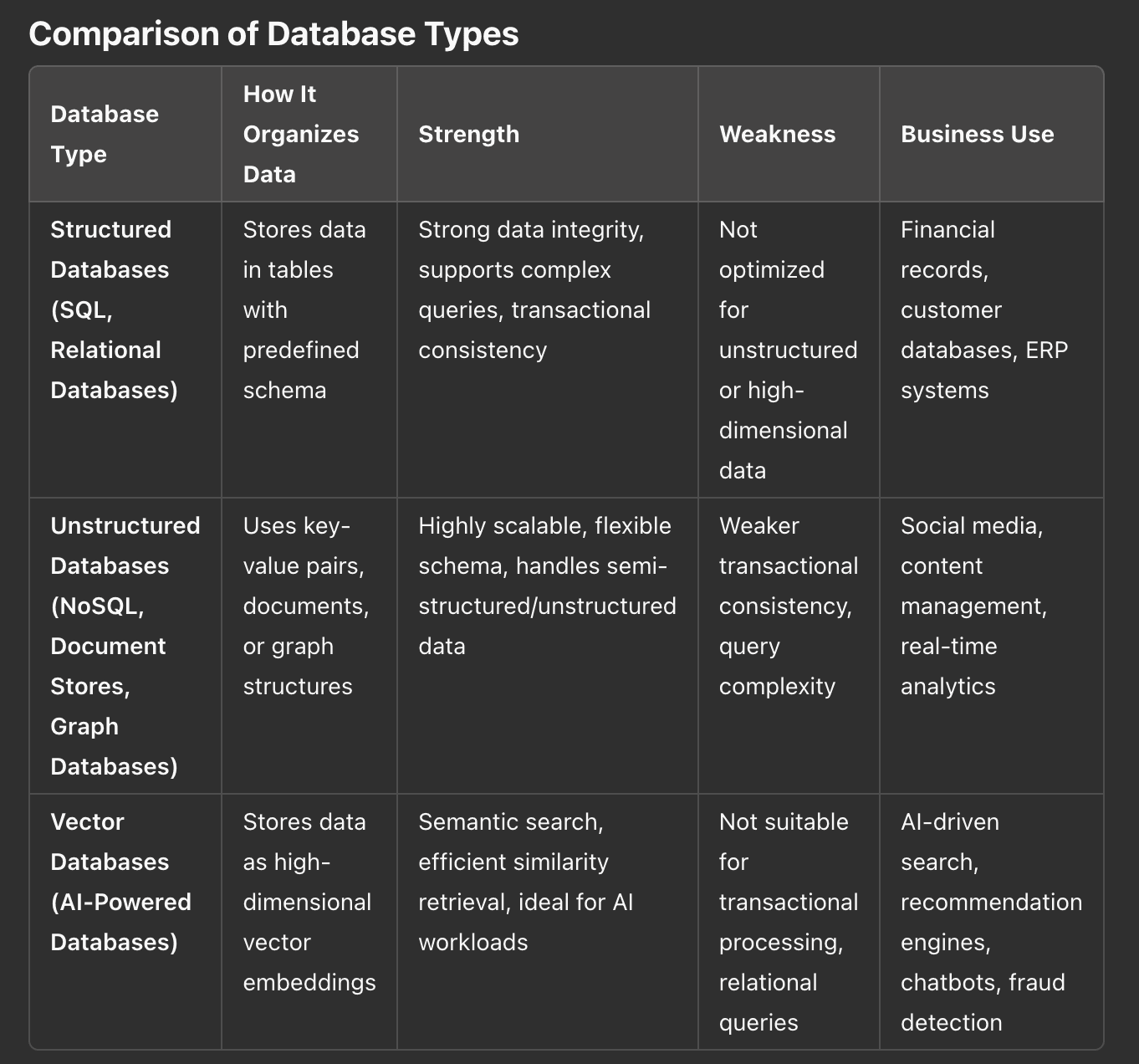
The Role of Vector Databases in AI and AI Agents
AI models process vast amounts of data, and traditional databases struggle with unstructured, high-dimensional data. Vector databases solve this problem by encoding information into vectors, allowing AI systems to retrieve data efficiently.
Why Are Vector Databases Critical for AI?
- Semantic Search & Context Awareness – Unlike keyword-based searches, vector databases enable AI models to find relevant data even when exact terms don’t match. For example, an AI chatbot can understand that “cheap hotel” and “affordable lodging” mean the same thing.
- Faster Information Retrieval – AI agents need to process information in real-time. Vector databases use Approximate Nearest Neighbor (ANN) Search, which speeds up searches even in billion-scale datasets.
- Memory for AI Agents – AI agents require persistent memory to store and recall past interactions. Vector databases allow agents to retrieve historical conversations and make context-aware decisions.
- Multimodal Data Processing – AI applications often work with images, text, and audio simultaneously. Vector databases store and retrieve this data in a unified way, enabling more sophisticated AI models.
Real-World Use Cases of Vector Databases in AI
- Chatbots & AI Assistants: AI-driven customer support agents use vector databases to remember past interactions and improve responses.
- Recommendation Engines: E-commerce platforms like Amazon and streaming services like Netflix use vector databases to provide personalized recommendations.
- Image & Video Search: Google Lens and Pinterest use vector-based retrieval for finding visually similar images.
- Fraud Detection & Cybersecurity: Banks and cybersecurity firms use vector databases to identify patterns and detect anomalies.
- Healthcare AI: AI-powered diagnostic tools analyze medical scans and retrieve similar cases for better diagnosis.
What Makes Vector Databases So Unique?
Where Vector Databases Have a Significant Edge
- Handling High-Dimensional Data – Unlike traditional databases, vector databases can efficiently process and store complex, multi-dimensional data like images, audio, and unstructured text.
- Semantic Understanding – Instead of searching for exact matches, vector databases find conceptually similar results, making them superior for AI-driven applications.
- Scalability & Speed – Using Approximate Nearest Neighbor (ANN) algorithms, vector databases retrieve relevant data faster than traditional databases when dealing with large-scale AI workloads.
Thanks for reading! This post is public so feel free to share it.
Where Vector Databases Are Not Suitable
- Transactional Data Processing – They are not designed for transactional systems that require strict ACID (Atomicity, Consistency, Isolation, Durability) compliance like banking and ERP systems.
- Relational Data Queries – If data has complex relationships (e.g., an HR database linking employees to departments and salaries), a relational database is a better choice.
How Mature Are Vector Databases?
- While vector databases are relatively new compared to SQL and NoSQL databases, they have matured significantly in the past few years.
- Major tech companies, including Meta (FAISS), Google, and Microsoft, actively invest in vector-based search solutions.
- As AI adoption grows, so does the demand for vector search, making these databases a critical component of future AI architectures.
Summary:
As AI continues to evolve, businesses that leverage vector databases will gain a significant competitive edge. Whether improving AI-driven search, enhancing AI assistants, or optimizing recommendation engines, vector databases unlock faster, smarter, and more scalable AI applications.
For AI-driven companies, investing in vector databases means staying ahead of the curve, enabling more intelligent automation, and delivering better AI-powered experiences to users. As AI adoption accelerates, vector databases will become a foundational technology for next-generation AI applications.