TL;DR: Top 5 Takeaways
- Autonomous AI: Manus, launched by Monica, executes tasks like building websites or screening resumes independently, not just suggesting ideas.
- Invite-Only Access: Its debut is locked to a select few, limiting hands-on validation despite massive hype [1].
- Stands Out: Unlike ChatGPT or Copilot, it delivers finished products, running solo without real-time babysitting.
- Innovative Edge: Multi-agent design and open-source plans could redefine business AI—if it scales beyond the gatekeepers [1].
- Unverified Claims: Boasts top GAIA scores (e.g., 57.7% on complex tasks), but lacks independent proof [2].
Imagine an AI that doesn’t just brainstorm a Japan trip or draft a report—it books your flights, builds a website, or ranks resumes, all from one prompt, while you step away. That’s the audacious pitch for Manus, China’s latest tech sensation, unveiled on March 5, 2025, by Monica, a startup with big ambitions [2]. Dubbed the “world’s first fully autonomous general-purpose AI agent,” Manus aims to act, not just advise—but here’s the catch: it’s locked behind an invite-only wall, leaving most of us peering through the glass [1]. For business pros tracking tech’s next wave, here’s everything you need to know about Manus: its features, how it differs from what’s out there, why it’s innovative, and why its bold claims are still a question mark.
Manus Unveiled: Features Behind the Curtain
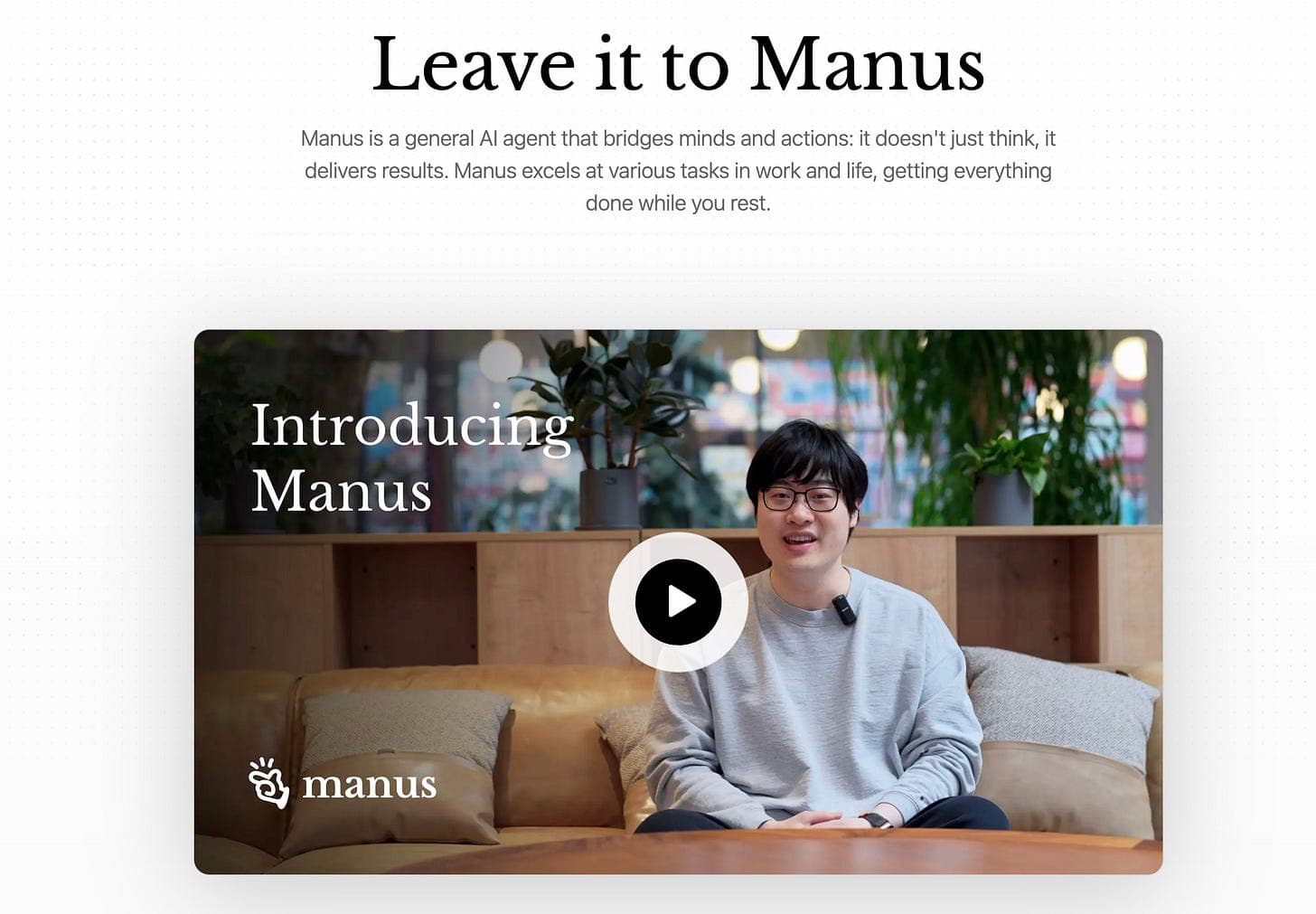
Manus promises to be a doer. It’s built to tackle multi-step tasks—think analyzing Tesla’s stock into a polished report or compiling New York property lists—delivering finished products, not just ideas [3]. Launched on manus.im, it runs on the cloud, working asynchronously: you assign a task, disconnect, and it chugs along solo [4]. A four-minute demo showed it screening resumes and spitting out an Excel ranking, all from a simple nudge [5]. But access? Tightly controlled. Yahoo News calls it “very limited,” with Monica doling out invites sparingly after server overload swamped their debut [1].
Monica, led by Xiao Hong, powers Manus with a “multi-signature” system—multiple AI models splitting duties like planning and execution [6]. Their “less structure, more intelligence” mantra aims for flexibility, handling everything from social media analysis to supplier hunts [7]. Sounds impressive, but with access restricted to a select few, it’s a tantalizing teaser most can’t touch yet [1].
How Manus Breaks from the Pack
Against today’s AI lineup, Manus stands out—if you can get your hands on it. ChatGPT or Microsoft’s Copilot excel at generating drafts—emails, code, summaries—but you’re the one finishing the job [8]. Manus doesn’t stop at HTML for a website; it aims to launch it. Tools like Google’s Gemini or DeepSeek’s R1 lean on real-time guidance, while Manus runs independently, mimicking a human assistant—if only more could test it [9]. Unlike AutoGPT, which demands tech savvy to configure, Manus keeps it dead simple: one prompt, one result, no fuss—though its invite-only status keeps that simplicity out of reach for now [1].
The gap is clear: current tools assist; Manus executes. But with Monica gatekeeping access, it’s a promise whispered to a privileged few, not a product you can deploy tomorrow [1].
Why Manus Feels Innovative
Why the hype? Manus could turn AI into a workforce player, not a helper—think automating HR grunt work or financial breakdowns [10]. Its multi-agent design ditches the rigid, single-model mold of GPT-4, offering a fresh take on adaptability [6]. Plans to open-source parts in 2025 could spark a boom in custom agents, letting businesses tweak without starting over [7]. And its focus on tangible outputs—deployed sites, ready reports—raises the bar beyond raw ideas [3]. If it scales beyond its locked doors, Manus might redefine AI’s role in your workflow [1].
The Big Question: Where’s the Proof?
Monica touts Manus as a GAIA benchmark champ, outscoring OpenAI’s Deep Research: 86.5% (Level 1, simple tasks), 70.1% (Level 2, moderate), and 57.7% (Level 3, complex) versus Deep Research’s 74.3%, 65.8%, and 47.6% [2]. GAIA’s no joke—humans hit 92%, and top public AI like H2O.ai’s h2oGPTe scores 65% [11]. A 57.7% on tricky tasks (e.g., synthesizing chaos) is bold, but it’s Monica’s claim alone—no independent testers back it up [1]. The public GAIA leaderboard hasn’t logged Manus, unlike GPT-4’s 15-30% [11]. No raw data, no failure cases, no testing details—just a demo and their word [5].
With access so limited, verification’s a pipe dream [1]. Their X account’s suspension on March 7 for “rule violations” doesn’t help—transparency’s thin, and the stats dazzle but don’t convince yet [12].
Manus: A Peek, Not a Product
Manus, China’s new AI star, dangles a vision of autonomous, results-driven tech. Its features—independent execution, multi-agent flexibility, tangible deliverables—set it apart from chatbots and research tools, hinting at a future where AI doesn’t just assist but replaces grunt work. Its innovative streak could shake up business tech, but its invite-only cage keeps it a mystery for most [1]. Until Monica opens access and proves its GAIA claims, it’s a shiny promise, not a tool in your kit. Watch it closely—if it delivers, it might just change the game.
Top 10 Reference Links
- Yahoo News SG, “Manus: Another DeepSeek Moment for Chinese AI?”
- Yicai Global, “China’s Monica Unveils Manus AI”
- Newsweek, “Manus AI Outperforms OpenAI, Says Monica”
- Global Times, “Monica’s Manus Faces Server Overload”
- YouTube, “Manus AI Demo Video,” Monica Official Channel
- South China Morning Post, “Monica’s Manus Targets Global AI Lead”
- Pandaily, “Manus: China’s Answer to Autonomous AI”
- OpenAI Blog, “ChatGPT Capabilities”
- DeepSeek, “R1 Launch Recap”
- Medium, “The Rise of Autonomous AI Agents”