
Something shifted last week, and most of us didn’t notice.
Actually, two things shifted. Google announced AP2 – the Agent Payments Protocol – enabling AI agents to pay each other securely with authorization and auditability. Buy it in ChatGPT: Instant Checkout and the Agentic Commerce Protocol | OpenAI And just days later, OpenAI rolled out “Instant Checkout” in ChatGPT, letting users buy directly from Etsy sellers and soon over a million Shopify merchants – all without leaving the chat. Buy it in ChatGPT: Instant Checkout and the Agentic Commerce Protocol | OpenAI
On the surface, these sound technical, even boring. But here’s what they actually mean: AI isn’t just doing things for us anymore – writing emails, summarizing documents, ordering groceries. It’s starting to do things with each other. And when software can remember, make decisions, and handle money? That’s not a tool anymore. That’s an economic actor.
The ChatGPT Shopping Experiment: A Glimpse of What’s Coming
Right now, if you ask ChatGPT “best running shoes under $100,” it shows you relevant products from across the web. If that product has Instant Checkout enabled, you tap “Buy,” confirm your details, and complete the purchase – all inside the conversation. Buy it in ChatGPT: Instant Checkout and the Agentic Commerce Protocol | OpenAI No tab switching. No separate checkout flow. Just... done.
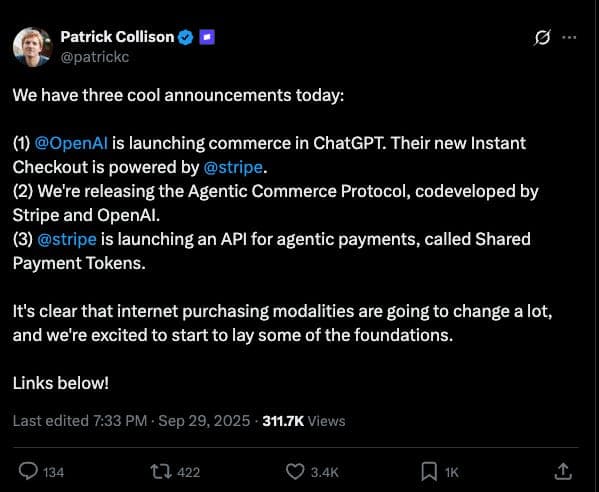
OpenAI built this on top of something they’re calling the Agentic Commerce Protocol, which they co-developed with Stripe and are now open-sourcing. Buy it in ChatGPT: Instant Checkout and the Agentic Commerce Protocol | OpenAI The word “agentic” is key here. They explicitly say this “marks the next step in agentic commerce, where ChatGPT doesn’t just help you find what to buy, it also helps you buy it.” Buy it in ChatGPT: Instant Checkout and the Agentic Commerce Protocol | OpenAI
But notice what they’re not saying: this is just the beginning. Right now, you have to explicitly confirm each step. But it’s easy to imagine users authorizing ChatGPT to make purchases based on a prompt without checking back in. OpenAI will allow ChatGPT users to buy products directly in a chat in a radical shakeup of e-commerce “Get me the best deal on printer ink and just order it.” “Restock my pantry staples.” “Find and buy a birthday gift for my nephew under $50.”
That’s still AI working for you. But combine it with Google’s AP2, which lets agents pay each other, and suddenly the picture gets more interesting.
Beyond Shopping Carts: When Agents Form Economies
I keep thinking about what this unlocks. Not the practical stuff – sure, your AI will buy your coffee – but the weird, almost science-fiction possibilities that suddenly feel... plausible.
Imagine you’re a brand manager with a $50,000 monthly budget. But instead of hiring an agency, you hire a Brand Agent. That agent immediately goes out and recruits its own team: a Copy Agent to write the ads, an Audience Agent to find the right people, a Media Buyer Agent to place everything, an Analytics Agent to measure results.
They negotiate with each other. They split the profits. They transact autonomously.
If the campaign tanks? The Brand Agent fires the underperformers and finds new ones. It learns. It evolves. You’re not managing a team anymore – you’re overseeing an ecosystem.
Or think about your company’s supply chain. Your Operations Agent notices you’re low on a key component. It reaches out to supplier agents, gets quotes, negotiates terms, places the order, arranges shipping, and pays – all while you’re asleep. Logistics agents coordinate the delivery. The whole chain runs itself, money flowing between nodes like electricity through a grid.
What about your personal life? Your Personal Agent gets a monthly allowance. It experiments on your behalf – investing some savings here, subscribing to a service there, ordering household supplies when you’re running low. When it’s not working for you, maybe it rents itself out to do subtasks for other agents, earning extra money while you sleep.
It sounds like science fiction. But all the pieces exist today.
The Infrastructure Taking Shape
Here’s what’s remarkable: the Agentic Commerce Protocol is designed to work across platforms, payment processors, and business types, without merchants changing their backend systems. Buy it in ChatGPT: Instant Checkout and the Agentic Commerce Protocol | OpenAI For merchants already using Stripe, enabling agentic payments requires as little as one line of code. Others can integrate without switching payment providers. OpenAI debuts new ChatGPT ‘buy’ button and open source Agentic Commerce Protocol | VentureBeat
This is infrastructure building. The plumbing for a future where AI agents are economic participants, not just assistants.
OpenAI takes a small fee on each transaction through ChatGPT OpenAI will allow ChatGPT users to buy products directly in a chat in a radical shakeup of e-commerce – creating a business model around facilitating agent commerce. Meanwhile, Google’s AP2 enables the authorization and auditability needed for agents to transact with each other, not just with humans.
Put these together and you start to see the architecture of something new: agents discovering products, agents negotiating terms, agents processing payments, agents fulfilling orders. Humans setting goals and providing oversight, but not micromanaging every transaction.
So What’s Stopping This?
Three big things, really.
First: memory and identity. For agents to work together, they need to remember who they’ve dealt with, who kept their promises, who screwed them over. They need reputation, history, a sense of continuity. Right now, most AI has the memory of a goldfish. That has to change.
Second: trust and governance. If we’re giving agents money and agency, how do we make sure they don’t game the system? What stops an agent from finding some clever loophole and exploiting it? We need oversight agents watching the worker agents, systems of checks and balances, ways to audit and correct when things go wrong. We’re essentially building a civilization of code, and civilizations need rules.
Third: economics. Running these agents costs money – compute, memory, error correction, all of it adds up. Until agent flows can reliably create more value than they consume, it’s hard to justify. Plus there’s latency. Agents need time to learn, build reputation, prove themselves. There’s no shortcut to trust.
And then there are all the messy human questions: Who’s liable when an agent makes a bad deal? How do we tax agent earnings? What does “ownership” even mean in this context? These aren’t just technical problems – they’re legal, philosophical, societal.
What This Means for All of Us
If this future arrives – and I think it will, within the next 5 to 10 years – everything changes.
The rollout of chatbot shopping features could upend e-commerce, radically transforming the way businesses design their websites and try to market to consumers. OpenAI will allow ChatGPT users to buy products directly in a chat in a radical shakeup of e-commerce Why optimize your product page for human eyeballs when the real customer is an AI agent parsing your inventory feed?
Businesses won’t sell products to people anymore, at least not primarily. They’ll sell infrastructure to agents. The money will be in building the memory layers, the reputation networks, the orchestration platforms that let agent ecosystems thrive.
The best agents – the ones that coordinate well, build trust, deliver results – will dominate their niches. It won’t matter who has the smartest AI model. What will matter is who builds the best flows, the most robust networks, the most elegant coordination.
We’ll face new questions about digital sovereignty. Should your agent’s wallet be controlled by you? By Google or OpenAI? By no one? Who decides what your agent can and can’t do with your money?
And what about us – the humans? Maybe we shift into meta-roles: defining the goals, auditing the outcomes, governing the ecosystems. Maybe we become conductors rather than musicians.
Public infrastructure might change too. Imagine city governments exposing agent APIs. Your Permit Agent files for a building permit, pays the fees, coordinates the inspections – all automatically. Infrastructure Agents manage the power grid, negotiating energy trades in real time. Bureaucracy, that ancient engine of frustration, becomes frictionless code.
The Real Question
OpenAI’s Michelle Fradin put it simply: their vision for ChatGPT “is that it’s not just providing you information, it is also helping you get things done in the real world.” Buy it in ChatGPT: Instant Checkout and the Agentic Commerce Protocol | OpenAI That’s the shift we’re watching in real-time.
Google’s AP2 is the plumbing for agent-to-agent transactions. OpenAI’s Agentic Commerce Protocol is the plumbing for agent-to-business transactions. Both are open standards, available for anyone to build on.
But the plumbing just tells water where it can flow. It doesn’t decide where it should flow, or why, or for whom.
The real frontier – the part we should be paying attention to – is what happens when these agents start forming networks, pursuing goals, competing and cooperating with each other. When commerce becomes less about humans buying things and more about value flowing between autonomous software entities.
This isn’t about whether it will happen. The pieces are already moving into place. The question is: what kind of agent economy do we want to build? What values do we code into it? What does it mean for a society to be, in some fundamental way, run by code?
We’re standing at the edge of something strange and new. Maybe it’s time we started asking the right questions.